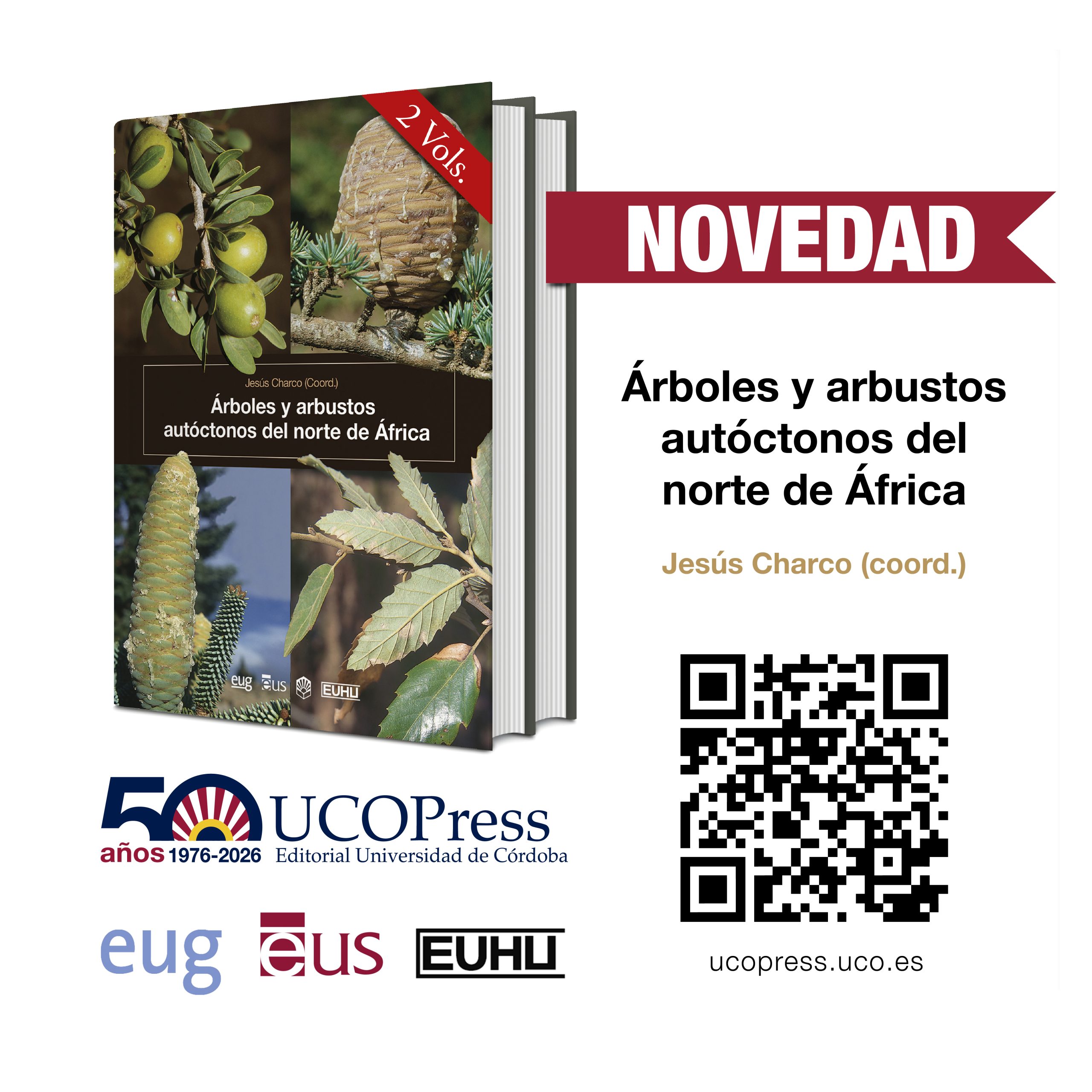
UCOPress, in collaboration with the universities of Granada, Seville and Huelva, has published the book Árboles y arbustos autóctonos del Norte de África (Native Trees and Shrubs of North Africa).
The aim of this new publication is to provide up-to-date information, a practical field guide and a useful working tool for lecturers and students on degree courses in Forestry and Agricultural Engineering, Biology, Environmental Sciences, Geography and other Earth Sciences, as well as for those studying Medicine, Pharmacy and other scientific disciplines. It may also be very useful for technicians, naturalists and, in general, for all professionals and enthusiasts interested in the study, management, conservation and restoration of the valuable North African ecosystems in particular and Mediterranean ecosystems in general, and of the significant biodiversity they harbour, which is of great global value.
This book covers the species most important for biodiversity conservation and the fight against desertification in North Africa: native trees and shrubs, which enrich the landscape, create and protect soil and moisture, and provide refuge for wildlife.
It includes all species of trees, shrubs, dwarf shrubs and woody vines: 880 species, grouped into 290 genera and 76 families. For identification purposes, it includes dichotomous keys, updated taxonomy, detailed morphological descriptions, information on flowering and fruiting periods, distribution maps and a carefully selected collection of over 1,500 photographs. One of the most original features of the book is the distribution maps. These maps are visual representations used to compare the distribution of species. Numerous maps allow for an instant comparison of the distribution of similar species, thereby enabling us to distinguish between them and better understand their co-evolution.
This book covers a vast area, stretching from the Atlantic coast of Senegal to the Red Sea in the east, and from the Mediterranean coast to the tropics of the Sahel in the south. It is a diverse territory, featuring the high Atlas mountain ranges in the northwest and a series of large mountain massifs scattered across the Sahara and the Sahel (Tibesti, Ahagar, Air, Ennedi…), major rivers—most notably the great Nile—coasts, and, above all, the vast Sahara Desert. The diversity of the territory is reflected in its vegetation, with coniferous and deciduous forests in the north, mangroves and subtropical savannas in the south, and the vast desert in the center. From a biogeographic perspective, the region covered in this work includes the boundary between two major floristic realms: the Palearctic and the Paleotropical.
This ambitious project has benefited from the invaluable contributions of more than 50 experts from various countries in Africa and Europe. Most of the authors, experts from a dozen universities, have participated in the various stages of national and regional flora projects, such as the Flora Iberica project or the floras of Andalusia (Western and Eastern) and northern Morocco. The content of this project is backed by extensive experience. The publication of these two volumes has been driven by the goal of disseminating technical and scientific knowledge to combat the major environmental challenges of the 21st century: biodiversity loss, erosion, desertification, and the proliferation of exotic and invasive species—all of which are particularly pressing issues in Mediterranean countries.
Links: https://ucopress.uco.es/producto/isbn-9788499279350/ (print edition) y https://ucopress.uco.es/producto/isbn-9788499279367/ (digital edition).
DOI: https://doi.org/10.21071/000112