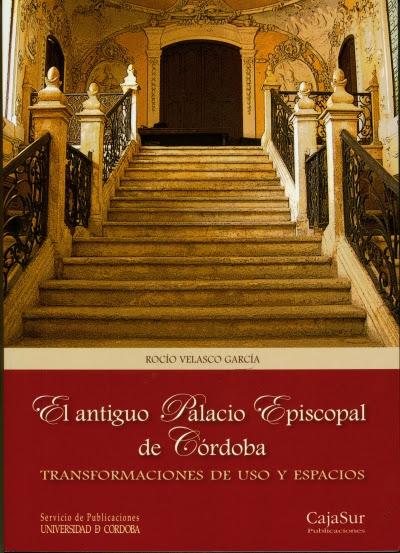
The former Episcopal Palace of Córdoba appears to be located on top of a Visigothic palace. Earlier, on the same site, within the Andalusian Alcázar, it extended even further into the terrain, where buttresses of the wall are still preserved. From the Reconquista until the end of the 20th century, it served as the seat of the bishops of Córdoba, undergoing various architectural modifications. The Palace also served as a residence for many Spanish kings and their retinues. In the 20th century, the bishop’s residence was moved to the San Pelagio Seminary, on Amador de los Ríos street.
This study by Rocío Velasco García, published by the University of Córdoba Publications Service in collaboration with CajaSur, focuses on the trajectory and uses of the property. Since 1971, the Episcopal Palace of Córdoba has been jointly owned by two proprietors: the Bishopric of the Diocese of Córdoba and the Spanish State, which delegated its powers to the Junta de Andalucía. The areas of the palace complex include the rooms designated for the offices of the Diocesan Curia, where the Diocesan Museum of Córdoba was previously located until 2006, shortly before the start of new adaptation works; archaeological remains of the Andalusian Alcázar, visible from the garden; vestiges of the palace stables, whose mangers are still standing; the bishop’s garden, whose design can still be traced today; and the Provincial Public Library, which incorporates the magnificent staircase by master Miguel Verdiguier, whose plaster decoration is based on an old 18th-century book of emblems.