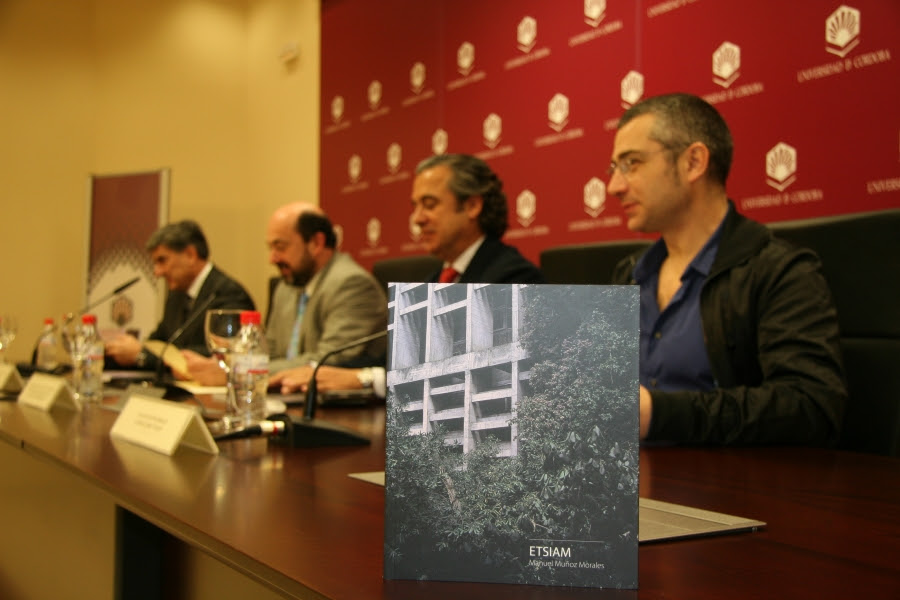
Photographer Manuel Muñoz presented the book ETSIAM this morning, a collection of images depicting the empty spaces of the former building of the School of Agricultural and Forestry Engineering, thus offering an approach to the memory of the University of Córdoba. The work was published by the UCO Publications Service in collaboration with the Rafael Botí Plastic Arts Foundation. The event took place in the Rectorate Press Room with the presence of photographer Manuel Muñoz; the Vice-Rector for Students and Culture, Manuel Torres Aguilar; the Director of ETSIAM, Alfonso García-Ferrer; and the Director of the UCO Publications Service, Fernando López Mora.
Manuel Muñoz has been working on the memory of cities and social memory for several years, as he commented at the beginning of his speech. The photographer was interested in this disused building and delved “into the experiences” of this type of construction. “I worked three full days that were impressive because the building still retains what the school represents for the city,” he added. In his opinion, it is “a beautiful document for the past to return to us.”
Manuel Torres Aguilar, Vice-Rector for Students and Culture, stated that the book “reflects the importance” that this center has had for the UCO, as “along with Veterinary Medicine,” it has represented the institution’s values. Torres explained that Manuel Muñoz presented the project to him a year and a half ago and that he found it very interesting for the University. Furthermore, he recalled that “the process of abandonment” of the building “was painful for many teachers and staff of the School,” but that thanks to Manuel Muñoz, it will endure. He also highlighted the importance that the UCO is giving to photography as a contemporary art form, as endorsed annually by the celebration of the Pilar Citoler International Photography Award.
The Director of the Higher Technical School of Agricultural and Forestry Engineering, Alfonso García-Ferrer, recalled the years he spent in the building since he began his university studies. He wished to state that it is “a fantastic book, with formidable photographs” about a place that holds “our affection.” “We hope someone buys the building and gives it life later,” he commented.
For his part, Fernando López Mora, Director of the Publications Service, valued the UCO’s “sensitivity” towards photographic art and referred to the book’s vindication of the institution’s “intangible heritage,” since beyond the construction, the “experiences” evoked by the empty spaces must be highlighted.