[Written by Federico Castro]
The University of Córdoba, through UCOCultura, presented Canteros/Bancales (Stonemasons/Terraces) by the Canarian artist Andrés Delgado in the fall of 2025. The exhibition was open to the public from October 23, 2025, to January 30, 2026. During this time, the artist created new works and planned site-specific installations for the La Neomudéjar Museum of Avant-Garde Art, a center that continues the work already undertaken, aware of the need to disseminate a body of work that transcends the merely aesthetic to become an ethical discourse on the preservation of the land and the transmission of ancestral knowledge.
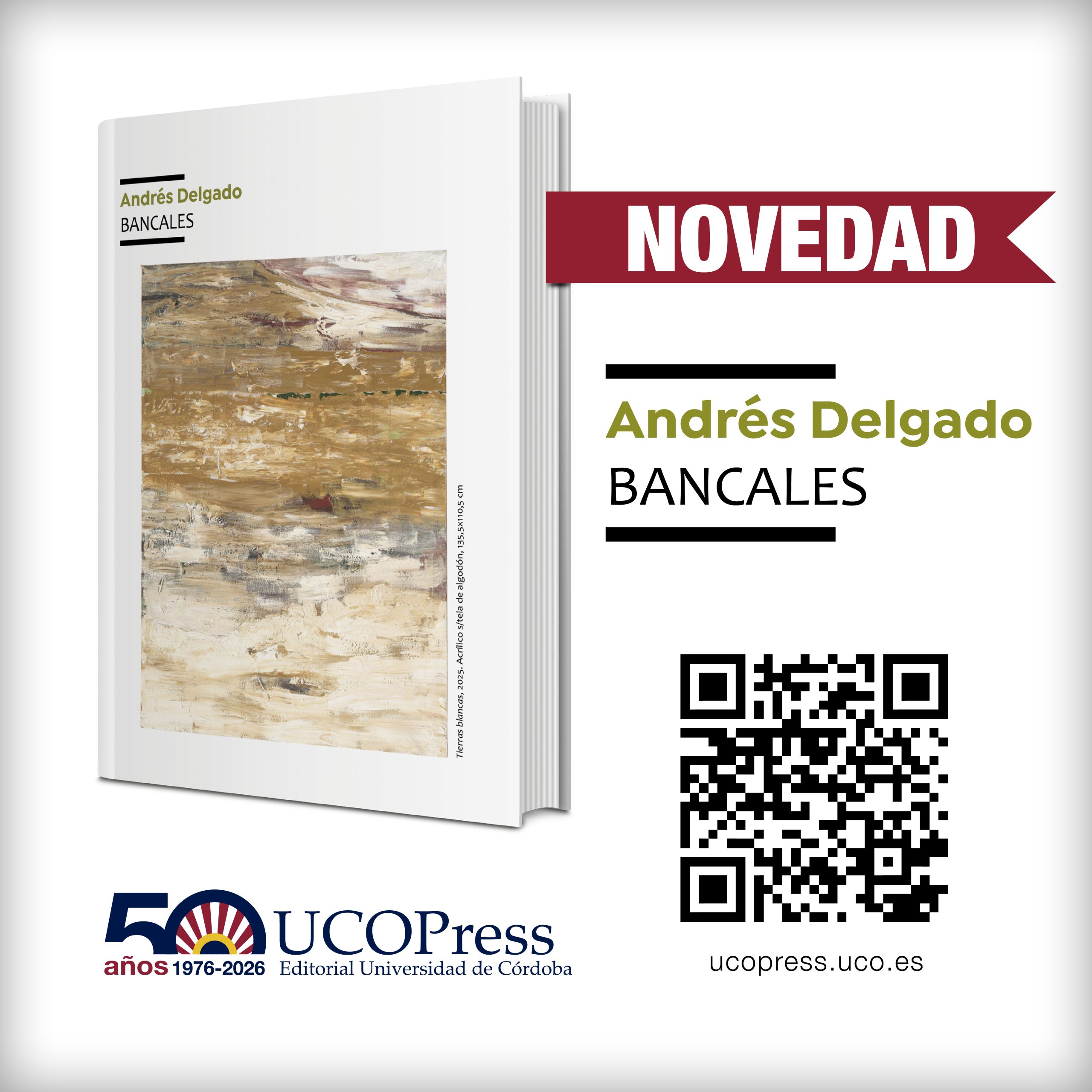
To coincide with the exhibition at La Neomudéjar, UCOCultura and UCOPress have published a new catalogue, Andrés Delgado. Bancales (UCOPress, Editorial de la Universidad de Córdoba, 2026) can be consulted at the following link:https:/doi.org/10.21071/000135
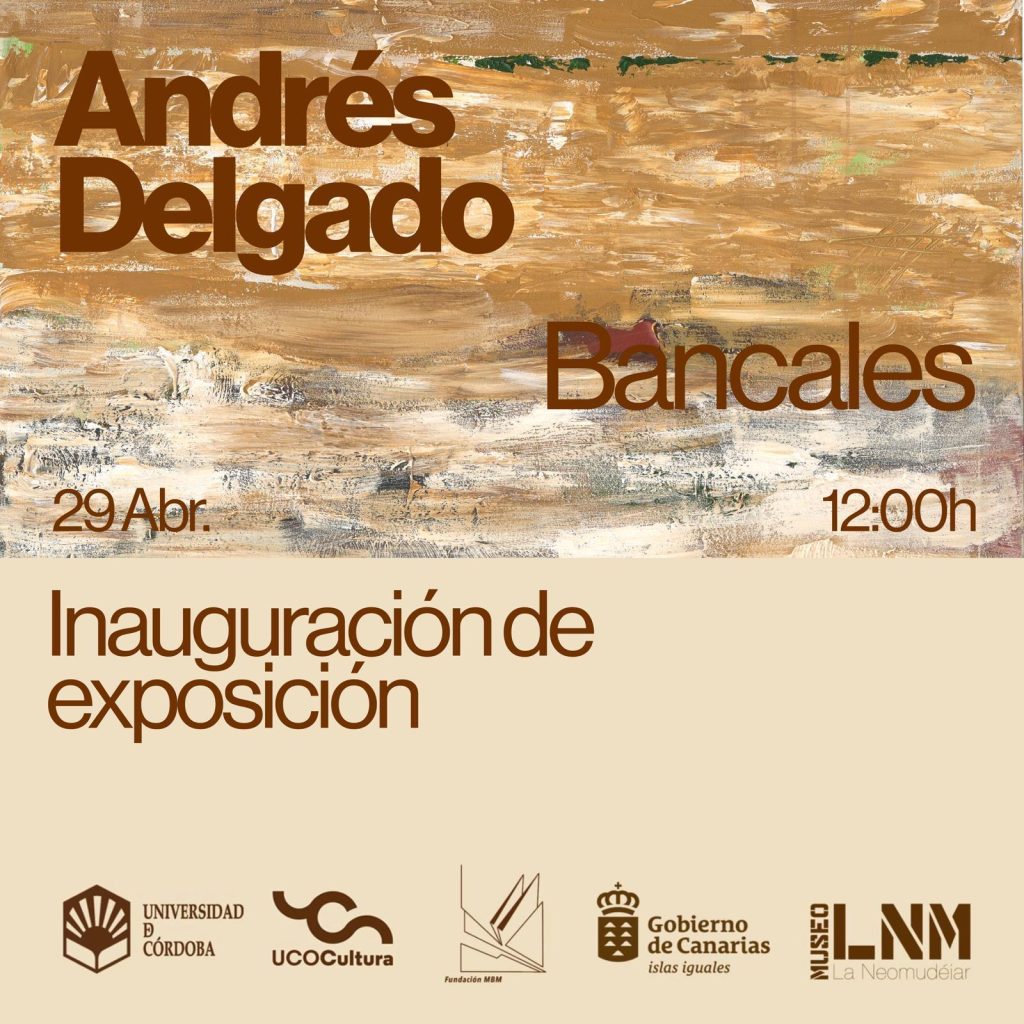
Exhibition Poster
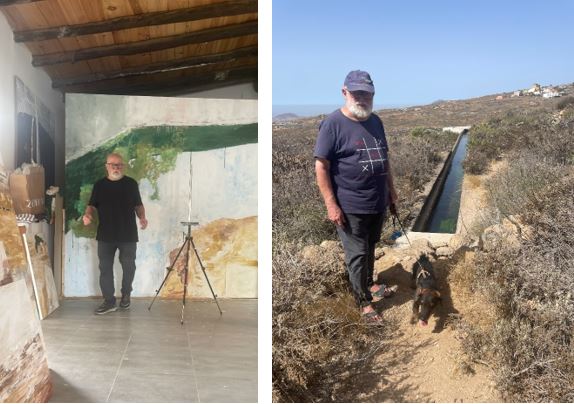
Left: Andrés Delgado in front of a pond in his studio in Arico (Tenerife).
Right: Andrés Delgado in front of one of the water pipes in Arico (Tenerife).
Andrés Delgado is a nomadic artist with over four decades of experience, who has lived between Tenerife and Madrid, always linking his artistic practice to a profound reflection on the relationship between landscape, identity, and collective memory. A committed artist and cultural manager, he transformed his Madrid residence into a meeting place, a true embassy of Canarian culture in the capital, paving the way for dialogue between artists, institutions, and diverse audiences. His work has been exhibited in museums and cultural centers in Spain and internationally, and he has been a driving force behind artistic exchange projects that enhance the visibility of contemporary Spanish art in global networks.
The CAV La Neomudéjar Museum in Madrid, part of the Art House Spain network created by Néstor Prieto and Francisco Brives, which has become a leading force in the mobility and internationalization of contemporary Spanish art thanks to a program of artistic exchanges with foundations, museums, and institutions across Spain and the Americas, brings an exhibition from Córdoba, presented by the artist, the University of Córdoba, and the MBM Foundation. This exhibition strengthens cultural exchange and critical reflection through art.
Néstor Prieto states that “Entering Andrés Delgado’s work is not like observing a landscape reflected in a postcard; it is like witnessing an autopsy of the land.” In Bancales, Andrés Delgado brings us closer to a specific territory: the terraces and stone quarries of Arico, in southern Tenerife, where the artist lives and works for extended periods.
Federico Castro Morales, curator of the exhibition, notes that “His paintings, seemingly abstract, are rooted in the daily observation of the island landscape. The haze that envelops the early morning mist, the calima that transforms mountains and volcanoes into blurred planes, or the light that turns profiles into silhouettes that seem to vanish, are natural phenomena that inspire a pictorial language that becomes a metaphor for deeper processes: the dematerialization of the landscape, the transformation of the environment, and the extinction of ways of life that, for centuries, made it possible for humankind to adapt to the environment. In the artist’s words, “In an environment where aridity dictates the landscape and water is a distant memory, art finds its channel in the void.”
In this exhibition, Andrés Delgado presents canvases painted with acrylics and paintings on degraded cardboard glued to boards, as well as jewelry from the series Stones, Open Air, and Stonemasons, made in the wood and in an alloy of silver and brass. The series addresses, with a critical eye, the A paradox of our time: in the name of sustainability, wind turbines, solar farms, and photovoltaic installations are being implemented that, while producing clean energy, are destroying the memory of the land and knowledge that could be of great use today. Thus, traditional practices are displaced by infrastructure that erases the cultural imprint of rural communities. Israel Muñoz and Fernando Lara state that “Andrés Delgado’s works are not just works to be contemplated: they are calls to action, urging us to take responsibility for nature, tradition, culture, and heritage.” For his part, Néstor Prieto sees in Andrés Delgado’s Terraces “a wounded body,” “a geography of resistance” through which he invokes “the ribs of a land that was forced to give life where there was only stone,” where today only “an aesthetic of abandonment” dwells, from which the only option is to join the artist in demanding “the sovereignty of memory in the face of the amnesia of progress.”
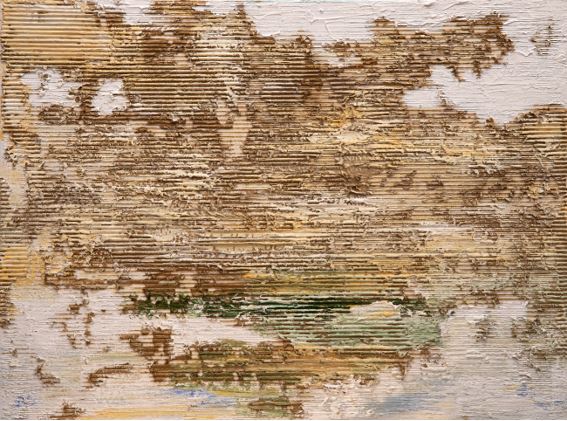
Terraces Series II, 2024. Acrylic, glue, and cardboard on canvas. 61×81 cm
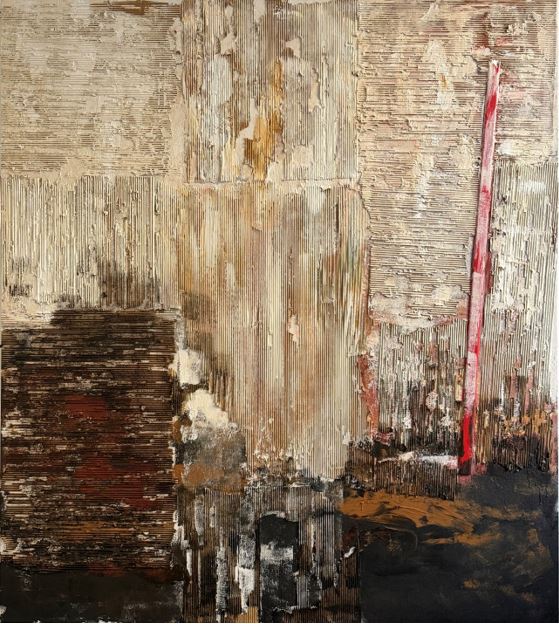
Tarosada 2, 2025. Acrylic on canvas, 180×160 cm
White Earths, 2025. Acrylic on cotton canvas, 135.5×110.5 cm
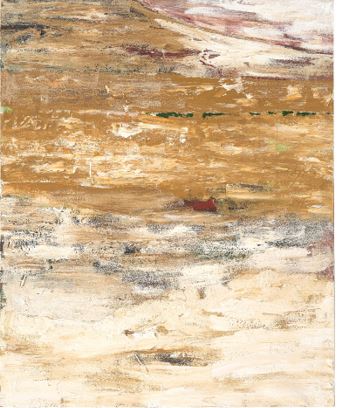
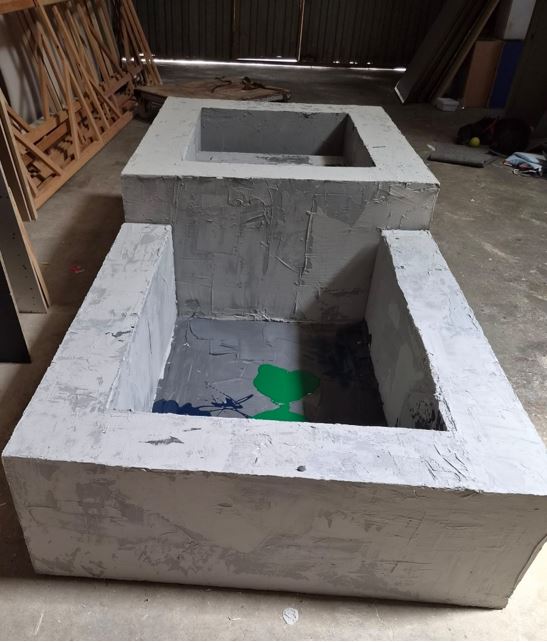
Water Distribution, 2026. Mixed media installation, dimensions variable.
Andrés Delgado was born in Güímar, Tenerife, in 1953. He studied Fine Arts in Santa Cruz de Tenerife and at the San Fernando School of Fine Arts in Madrid.
In 1969, he won first prize for painting in Santa Cruz de Tenerife, and in 1972, he held his first exhibition at the Ateneo de La Laguna.
Since 2010, he has been a member of the Tres en Suma collective in Madrid.